



One of Bolzano's Most Distinctive Streets: Via Cassa di Risparmio
23 June 2026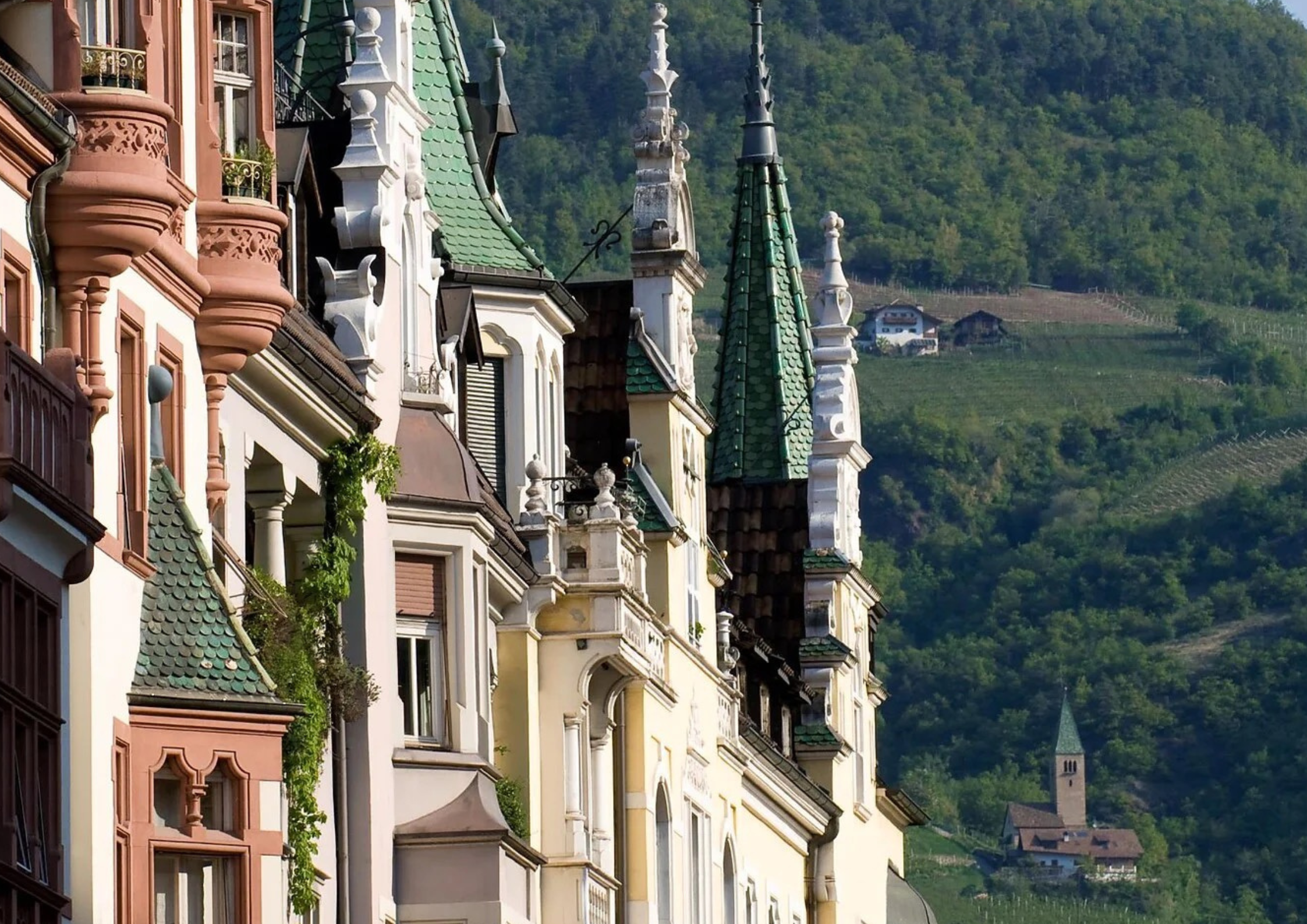
One of Bolzano's Most Distinctive Streets: Via Cassa di Risparmio
Among the streets that best define Bolzano Bozen’s historic centre, Via Cassa di Risparmio holds a special place. Designed at the end of the nineteenth century by the municipal architect Sebastian Altmann, it was created to connect the city hospital with Via dei Vanga, forming a north-south axis that enclosed the medieval core of the city along the western side, parallel to the Talvera stream.
The development of this area became necessary as Bolzano experienced rapid population growth under the leadership of Mayor Julius Perathoner (1895–1922). The arrival of electricity and the railway transformed the city and encouraged its expansion beyond the old town. Urbanization began after the Bolzano Cassa di Risparmio Bank acquired several plots of land along the Talvera and donated part of them to the municipality on the occasion of Emperor Franz Joseph’s fiftieth jubilee in 1898.
The bank’s headquarters were later constructed between 1904 and 1907 by architect Wilhelm Kürschner, then head of the municipal technical office. Originally designed in Neo-Baroque style, the building was remodelled in 1938 by Francesco Rossi according to the principles of Italian Rationalism. The original agreement between the Cassa di Risparmio Bank and the municipality established that the northern section of the street would retain the name Sparkassenstraße, while the southern section would be named Kaiser-Elisabethstraße in honour of Empress Elisabeth, better known as Sissi.
A key element in the development of the area was the new Talvera Bridge, designed by engineer Wagner Birò of Graz and inaugurated on 4 November 1900. With its wide carriageways, it anticipated the arrival of the automobile in Bolzano by several years.
The urban development of the street was completed by the construction of several important public buildings, including today’s Civic Museum, designed by Alois Delug in a castle-inspired style, and the former Austro-Hungarian National Bank building, which later became the Bank of Italy and now houses the South Tyrol Museum of Archaeology.
During the Fascist period, the two sections of the street, together measuring around 400 metres, were unified and renamed Via Regina Elena. The architectural harmony originally conceived by architects Strehle and Cassel in 1905 was partially altered when the Cassa di Risparmio adopted its Rationalist appearance in 1938. Today, the austere and monumental bank building, protected by the Fine Arts Authority since 1988, stands in contrast to the elegant façades lining the street, characterized by decorative gables, bay windows, turrets and framed openings inspired by Bavarian Baroque architecture with Romanesque and Renaissance influences.
Yet the street is not only an architectural landmark; it is also rich in historical traces. Above the entrance of house number 1, a marble cameo depicting the Virgin Mary holding the Child Jesus bears the opening words of the oldest known Marian prayer, dating from the third or fourth century: Sub tuum praesidium confugimus.
At number 6/1 lived the young composer Heinrich Gerstenberger, born in Prague in 1900, who moved to Bolzano with his family in 1910. A remarkable but largely forgotten talent, he died at just twenty-seven years of age.
Between 1905 and 1933, the Civic Museum building hosted concerts organized by the Musikverein (Music Association), performances by renowned soloists and student recitals, including those of the future conductor Carlo Maria Giulini. The current Sparkasse Academy building served as the headquarters of EIAR, Italy’s national radio broadcaster, from 1931 onwards.
Further along the street, towards Via Dante, a decorative stucco frieze depicting musical instruments marks the site of the former Fidele Socin accordion and harmonium factory, whose instruments were renowned throughout the world until the company ceased operations in 1958.
Via Cassa di Risparmio concludes with another significant landmark: the Dante Alighieri School, designed in the early twentieth century by municipal architect Gustav Nolte. Together, these buildings and stories make the street a remarkable open-air archive of Bolzano’s cultural, architectural and social history.
Image: Via Cassa di Risparmio, Courtesy Südtirol.info