

Person of the Month: Saman Kalantari
25 April 2026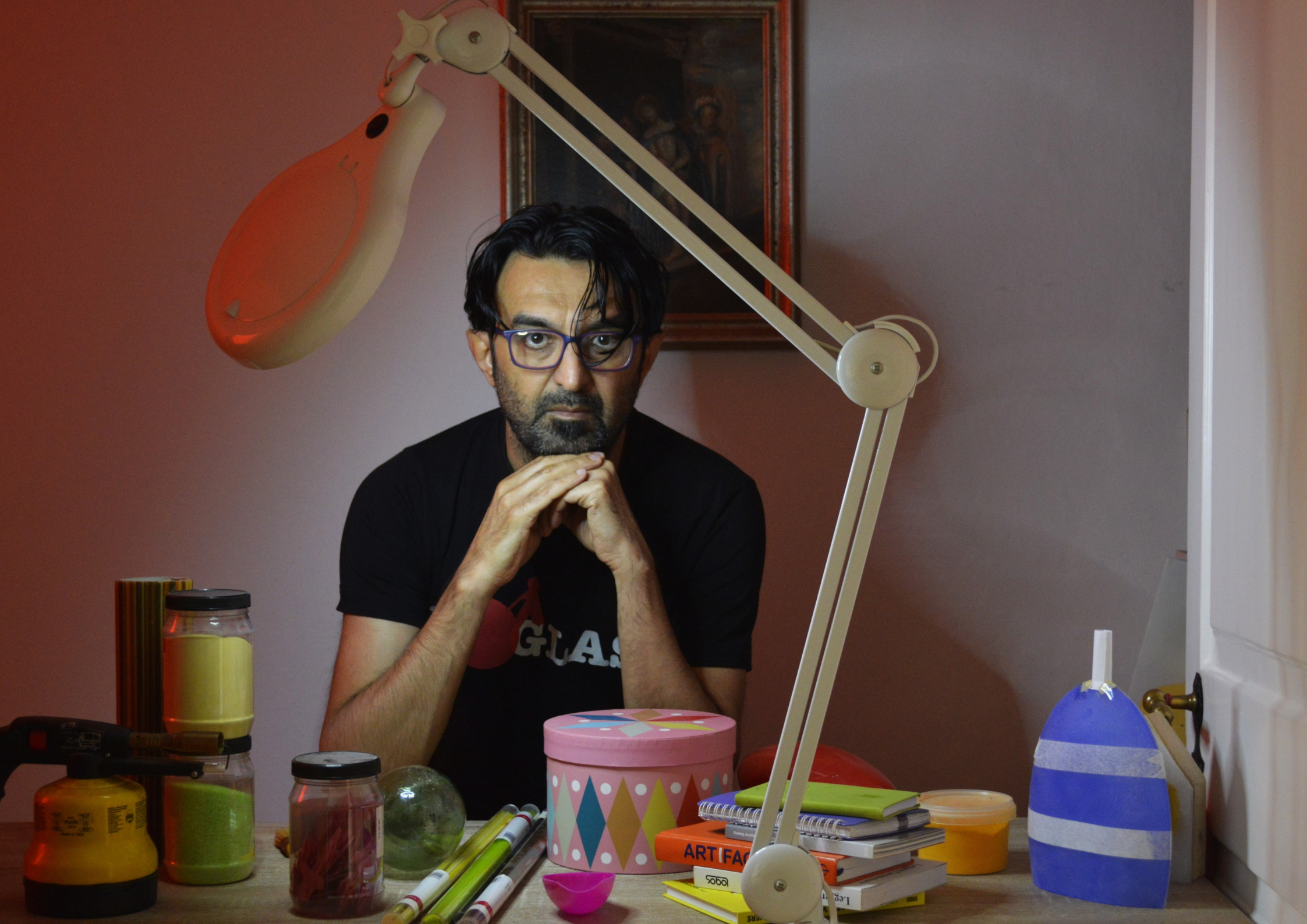
Person of the Month: Saman Kalantari
From the Iranian city of Shiraz, he set out twenty years ago on a journey that eventually brought him to Italy, where he now calls Bolzano home: the artist Saman Kalantari. His works, especially those in glass, have earned him recognition well beyond national borders. And yet, in the course of our conversation, it is when he speaks of clay that his voice truly comes alive: a living, pliable material he feels deeply connected to, and to which he returns with ease, as if it were an original language.
Saman, your artistic practice began with ceramics, but over time, you have explored different materials. What led you in that direction?
I’ve always had a very strong connection with clay, which remains something very special to me. It’s a soft, plastic material, warm to the touch, almost alive. When I work with it, I feel as though boundaries dissolve; it’s as if I become part of the material, and the material becomes part of me. Especially when I worked on the wheel, it felt like an extension of my body. No other material has ever given me that same sensation. It’s something deeply physical, but also very intimate, like a meeting between two presences that recognize each other. And often the trace of the finger remains there, in the clay, like a mark that does not disappear: a memory of the gesture, of presence, of passage. Over time, however, I felt the need to step outside this safe space and open myself up to other materials and languages.
So you prefer experimenting rather than creating a well-defined object?
Not always, but in most cases, yes. I’m curious to see how far I can push different materials, what they can become, where they can go. This process interests me more and more, also for the sake of the research itself, not necessarily for the finished object. Sometimes it fails, or in something broken, unresolved, something that doesn’t meet the initial expectations. It’s a bit like walking through an unfamiliar forest: you’re not looking for a precise destination, but you let yourself be guided by paths, detours, and whatever you encounter along the way.
Do you usually start with a clear idea, or do your works evolve as you create them?
Sometimes I begin with an initial idea, a fairly clear intention, but then the work shifts, changes direction, takes me elsewhere. It often happens that I “lose myself” in the making, following intuitions, small gestures, and decisions I hadn’t planned. But perhaps, rather than losing myself, that’s where I actually find myself. The work takes shape in that space between what I imagined and what happens as I create it.
You have exhibited in many shows around the world—what have these experiences left you with?
Exhibiting in many different places means, first of all, traveling—moving through cities, meeting people, and entering different cultures. That in itself is already something valuable.
In the end, making art is also about this: searching for a form of communication, a way to connect with others. What has stayed with me most strongly is the awareness that, beyond our differences, we have far more in common than we often think. We tend to focus on distances rather than similarities. And yes, I believe art is a universal language: a work can move someone deeply, even without sharing the same language.
Can we consider Bolzano your adopted city? What is your relationship with this place?
To understand this feeling, I have to go back to my origins: Shiraz, my hometown, where I was born and lived for 32 years. Even there, I used to travel often for various reasons—I worked in tourism as a tour guide. Sometimes I even felt the urge to escape, to experience new places and new lives. And yet, every time I returned to Shiraz, even from 20 or 30 kilometers away, I would feel a sense of relief. I felt I was coming home—to a place I knew, in its good and bad, among friends and family. Today, I can say I feel something similar toward this place as well.
Whenever I return to Bolzano after a long trip or time away, even while still on the train, I can feel it: I’m coming back to a place I know, among friends and familiar faces, to a place I can call home. It’s a beautiful feeling when I step out of the station and suddenly hear someone say, “Hi Saman,” and as I turn around, I see a familiar face.
In the end, I see it this way: indeed, the river that flows here is not the same river that flows in my city; indeed, the sky above here is not the same sky above my hometown; indeed, the air I breathe here is not the same as the air where I was born. And yet, from a broader and deeper perspective, we share everything on one single planet with all its inhabitants. Sometimes, when I see an airplane crossing the sky and leaving a white trail, in my imagination,n I try to extend that line from here all the way to Shiraz.
Image: Saman Kalantari, Courtesy Saman Kalantari