


Three Streets for Three Remarkable Women: Angela Nikoletti, Maria Delago and Maria Winkelmann
01 November 2026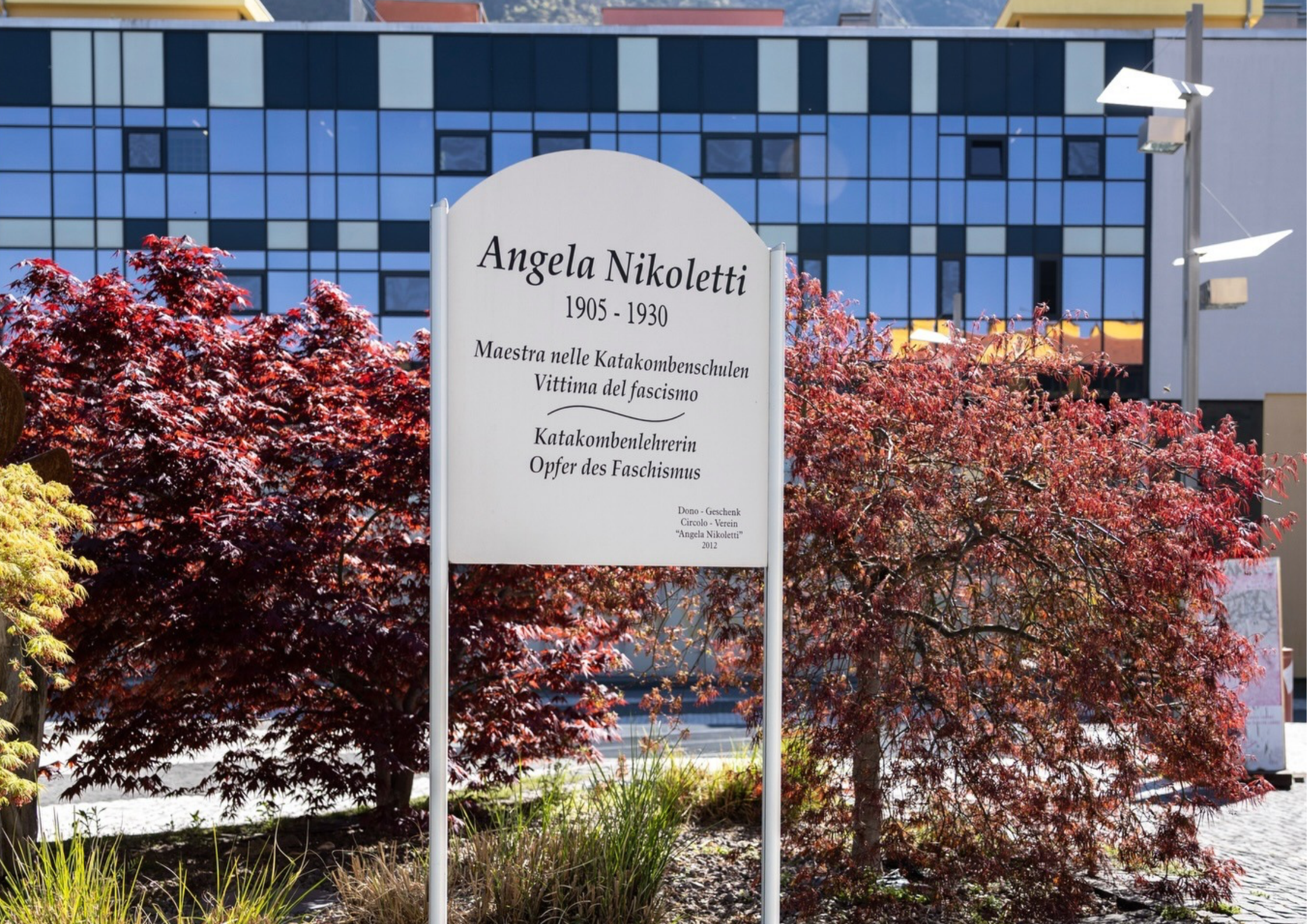
Three Streets for Three Remarkable Women: Angela Nikoletti, Maria Delago and Maria Winkelmann
As previously reported, fewer than thirty of the approximately four hundred streets and squares in Bolzano Bozen are named after women, a figure in line with those of other Italian cities. Excluding the five religious figures commemorated in the city’s street names, the women represented include politicians, members of the resistance, scientists, noblewomen and archduchesses who have left a profound mark on local history, culture and community life. Some challenged the conventions of earlier centuries by following paths that were unusual for their time; others, during the twentieth century, paid for their political convictions or social commitment with their lives.
One particularly emblematic story is that of Angela Nikoletti, who was born in Magrè sulla Strada del Vino on 31 May 1905. In 1922, she attended the first year of a teacher-training institute in Zams, in Austrian Tyrol. When she returned home for the holidays, the Fascist authorities denied her permission to continue her studies in Austria. She was eventually able to complete her second year, but the political situation in South Tyrol meant that she could never legally practise her profession.
In 1925, private German-language teaching was also declared illegal, a measure intended to prevent the establishment of the so-called Katakombenschulen, or clandestine schools. Determined to defend the local language and culture, Angela secretly taught around 30 children in her home in Cortaccia. After her activities were discovered and she was reported by the local podestà, she was arrested and imprisoned in Egna. She contracted tuberculosis in prison and, after years of serious illness, died at just 25. The square commemorating her is located in Oltrisarco.
Another remarkable woman from the early twentieth century was Maria Delago, born in Glorenza in 1902, the second of five siblings. Artistic talent ran in her family: her father enjoyed painting and drawing, while her mother, Rosa, decorated furniture. During her school years, Maria demonstrated considerable ability as both an artist and a writer. In 1916, she completed the Bürgerschule, or civic school, in Merano with excellent marks. She subsequently obtained a qualification as an educator, but her passion led her to enrol at the School of Applied Arts (Kunstgewerbeschule) in Vienna.
In 1925, she received an award of 150 Austrian schillings for a painting depicting the Madonna. Maria later moved to the Gries district of Bolzano Bozen and opened a small studio in Via Museo, from which her early works found their way into the homes of the city’s bourgeois families. During the 1930s, she continued her studies in the Netherlands and Munich. Her principal artistic practice was sculpture in clay and glazed ceramic, although she also worked with bronze and pursued drawing, painting and etching.
Her works can still be found in churches, museums and public buildings throughout South Tyrol and Tyrol. After the Second World War, she also became part of the first group of members of the Südtiroler Künstlerbund, the South Tyrolean Artists’ Association. She died in Bressanone in 1979, aged 77. Maria Delago is commemorated by a small square at the intersection of Via Vintola, Via Bottai, Via Weggenstein and Via Andreas Hofer.
Looking further back in time, we encounter the scientist Maria Winkelmann, born on 25 February 1670 in Panitsch, near Leipzig, in the German state of Lower Saxony, as described in the original account. From an early age, she was educated by her father, a Lutheran pastor who believed in equal educational opportunities for both sexes. At the age of 13, she lost both parents and continued her education under the guidance of her guardian, her uncle Justinus Toellner.
Maria Margarethe developed an interest in astronomy at a young age and had the opportunity to become a student, apprentice and eventually assistant to Christoph Arnold Sommerfeld, known as the “farmer astronomer”. Their research work led to the discovery of a comet in 1683. Her name appears on a street sign in the southern industrial area of Bolzano Bozen, commemorating her contribution to science.
Image: Angela Nikoletti Street, Courtesy @WhereWeBelongBZ