



Why Huck am Bach continues to captivate
11 August 2026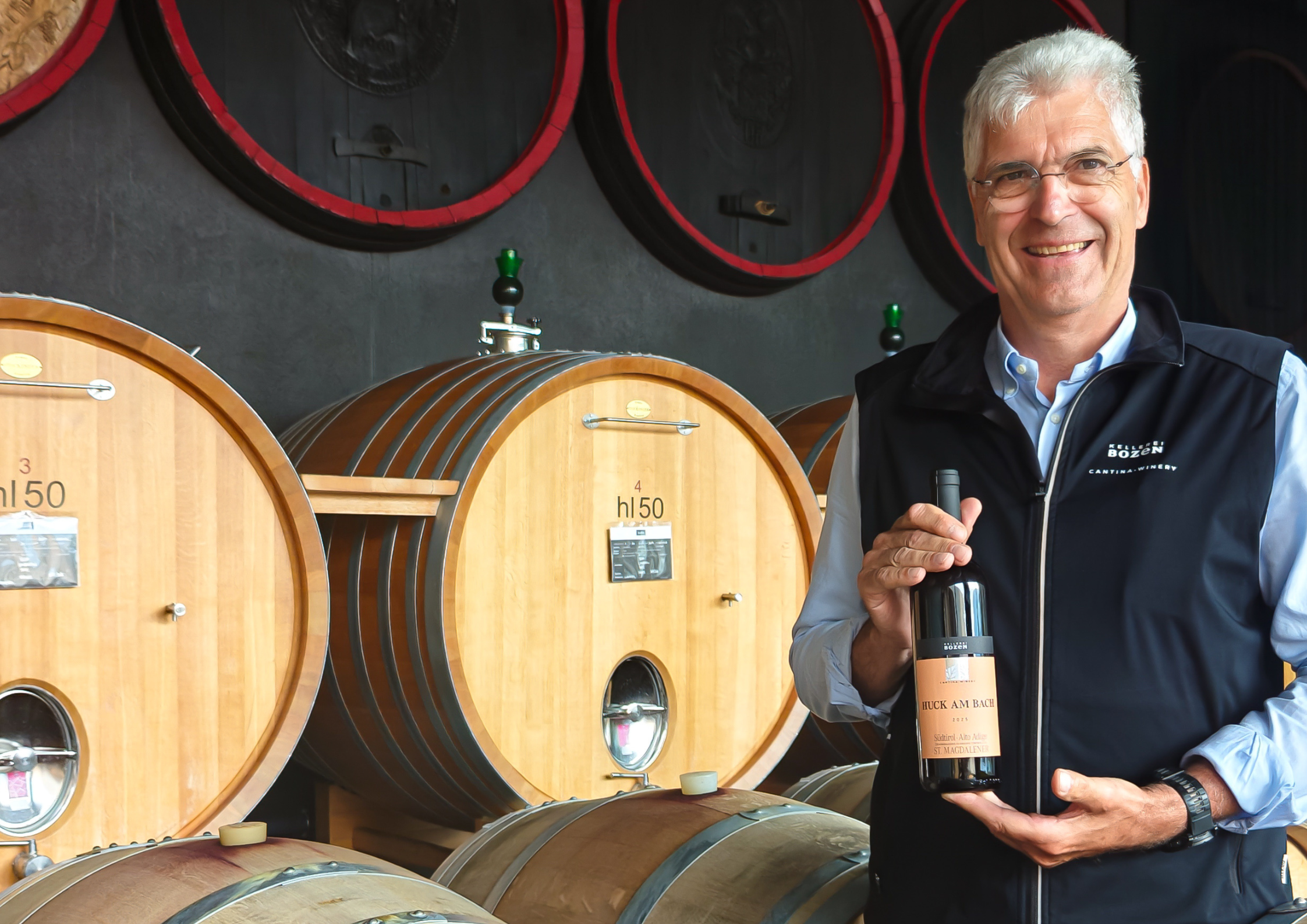
Why Huck am Bach continues to captivate
40th anniversary: Stephan Filippi, head winemaker at Kellerei Bozen-Cantina Bolzano, looks back on the history of a unique Bolzano Bozen wine.
For four decades, Huck am Bach has stood for a wine inextricably linked to Bolzano Bozen and the sun-drenched slopes of St. Magdalena. Few other labels from Kellerei Bozen-Cantina Bolzano reflect the distinctive characteristics of this terroir so expressively. In this interview, head winemaker Stephan Filippi looks back on the origins and development of this distinctive St. Magdalener, a wine that has accompanied him since the beginning of his career.
When the sun shines for many hours on the porphyry-rich slopes of the St. Magdalena hills and the nights remain pleasantly cool, the ideal conditions for an outstanding vintage wine are created. Huck am Bach originates from one of the largest contiguous estates in the St. Magdalener area. The Plattner family initially produced their own Vernatsch, cultivated together with Lagrein in a mixed planting, before the estate became a full member of what was then St. Magdalena Winery in the 1980s.
“I practically grew up with this wine,” says Filippi. Even as an intern, the future Kellerei Bozen-Cantina Bolzano head winemaker still bottled Huck am Bach by hand in the Bocksbeutel, the characteristically flat-bellied Franconian wine bottle. “In the 1990s, we then switched to the label we use today,” he recalls.
Something special from the very beginning
When Huck am Bach was introduced as an independent selection 40 years ago, the objective was clear: to express the potential of the finest St. Magdalener vineyards through a wine with an unmistakable character. From the outset, low yields, careful hand harvesting and strict grape selection were at the heart of its production.
Over the decades, it developed into one of South Tyrol’s best-known St. Magdalener wines. The merger of St. Magdalena and Gries wineries eventually gave rise to today’s Kellerei Bozen-Cantina Bolzano, a period Filippi still remembers well.
“The first vintage under the new structure was a delicate but exciting undertaking. The production capacity here is on a completely different scale compared with what it was at St. Magdalena Winery. Nevertheless, we managed to preserve the wine’s nuances and even refine them further.”
The results speak for themselves: today, Kellerei Bozen-Cantina Bolzano produces between 100,000 and 120,000 bottles of Huck am Bach every year. Its main markets are South Tyrol and southern Germany.
Maturity as a hallmark
One of Huck am Bach’s defining characteristics is its ability to evolve over time. As it matures, the wine gains depth and complexity. Alongside its fresh fruit character, delicate spicy notes emerge, together with hints of cocoa, tobacco and Mediterranean herbs. It is precisely this ageing potential that makes Huck am Bach a wine capable of captivating well beyond the first impression.
Four decades of quality
Forty years after its first bottling, much has changed: today, the vineyards are managed with even greater precision and sustainability, cellar work has become more meticulous, and knowledge of the individual growing sites has continued to expand. What has remained unchanged, however, is the ambition to reflect the wine’s origins as authentically as possible in the glass.
Photo caption: Winemaker Stephan Filippi presents Huck am Bach, a wine with which he has been closely connected for 40 years. (Photo: Ursula Pirchstaller). Text: Ursula Pirchstaller.